Root Chakra Symbol Meaning
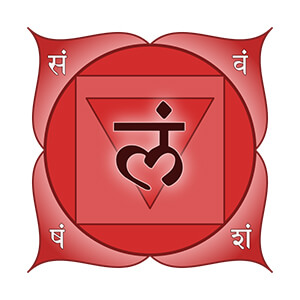
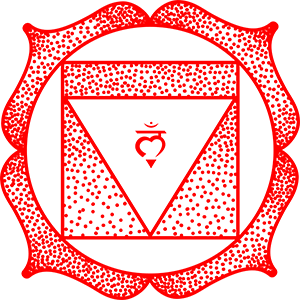
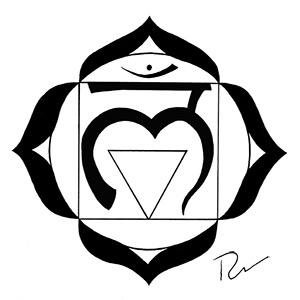
The root chakra symbol is depicted as a lotus flower with four petals. Each of these petals represent a specific mental state associated with the root chakra. In addition, the root chakra symbol includes a square, a triangle, a crescent moon, and a circle. This article will unpack the inner meaning of each of these powerful geometric forms within the root chakra symbol.
Understanding the Root Chakra Symbol
Every aspect of the root chakra symbol reveals another facet of this fundamental chakra in the human body. Understanding the root chakra symbol assists in mastering the energy of this chakra as the foundation of a personal spiritual path. The ancient root chakra symbol is a map of the journey towards freedom and liberation.
Share this page with a friend!
Root Chakra Symbol Topics to Explore
The topics in this comprehensive root chakra symbol guide will help you to support, purify, and unlock the energy of your root chakra! These topics include the details of the root chakra symbol and practical tools for healing and balancing the root chakra. Take a deep dive into the psychology and spirituality of this critical energy center and the beautiful root chakra symbol!
Watch nearly 300 videos on our YouTube channel!
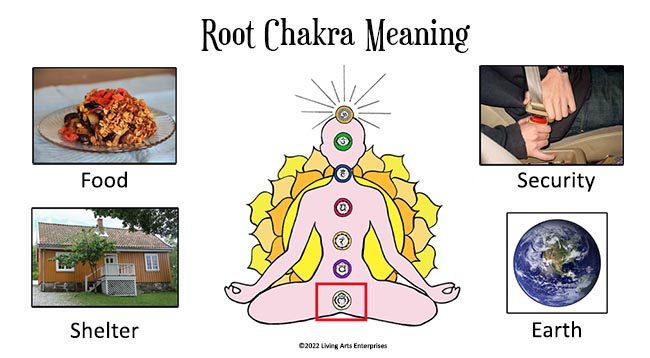
The root chakra symbol can be explored on many levels. The root chakra establishes the foundation for the other major chakras. The root chakra is our connection to the physical plane. The focus of the root chakra is survival: food, shelter, safety, comfort, and belonging. Activating this chakra is a careful process described in ancient texts and based on the body’s powerful energetic system.
Role of the Root Chakra in the Body
The name for the root or base chakra in Sanskrit is Muladhara. “Mula” means “root.” “Adhara” means “base or support.” Each of the seven major chakras have Sanskrit names that reveal their function. learn more in the article Chakra Names and Sanskrit Meanings.
Grounding through the Root Chakra
The root chakra helps you to ground in your environment. This is also the place where ancestral memories reside. One of the challenges in activating the root chakra is clearing traumatic memories or records stored in this chakra. This can be done through spoken affirmations, the use of mantras, various forms of prayer, meditation, and service to others.
Associated Organs in the Body
The root chakra governs the lower part of the body. This includes the feet, legs, knees, hips, pelvis, lower back, and lower spine. These areas of the body establish balance and stability. Other organs related to the root chakra are the organs of elimination: the bladder and the colon.
Root Chakra and Reproduction
The root chakra also connects to the reproductive system. This is a shared function with the sacral chakra. The root chakra is the place where we process and transform energy, thoughts, and experiences related to security and safety. Learn more in Chakras and Organs of the Body.
Root Chakra Symbol: Four Lotus Petals
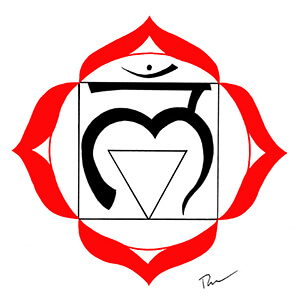
The four lotus petals of the root chakra symbol represent four different mental states. However, interpretations of these mental states vary widely. Most often, the four petals of the base chakra are viewed as mind, intellect, consciousness and ego.
Sanskrit Lotus Petal Names
In Sanskrit, these petals are called Manas (mind), Buddhi (intellect), Chitta (consciousness), and Ahamkara (ego). Taken together, these four aspects of the root chakra symbol are called the Antahkarana or the “inner instrument.”
Meanings of the Four Lotus Petals
Some of the variations in the meanings of the four root chakra petals may be due to translations from Sanskrit. Sanskrit is a language that assigns many meanings to a single word. Thus, determining the exact meaning of a word in a particular context can be difficult. The following is a simple definition of each of these mental states:
- Manas (1st petal, mind)- seat of instincts and desire
- Buddhi (2nd petal, intellect)- intuition and higher mind
- Chitta (3rd petal, consciousness)- memory and life experiences
- Ahamkara (4th petal, ego)- the body and senses
Four Types of Longing
In some translations, the four petals of the root chakra symbol represent four forms of longing. This is connected to the Hindu concept of Purusarthas. Purusarthas frames these longings as four goals related to human life:
- Dharma (psychological longing)
- Artha (soul longing)
- Kama (physical longing)
- Moksha (longing for spiritual liberation)
Four Aspects of Higher Consciousness
In addition to the four forms of longing noted above, the four petals depicted in root chakra symbols are also symbolic of four specific aspects of higher consciousness. These aspects can be outlined as:
- Great joy
- Natural pleasure
- Delight in controlling passion
- Blissfulness in concentration
Click to explore a related article on this website!
Root Chakra Symbol & the Five Elements
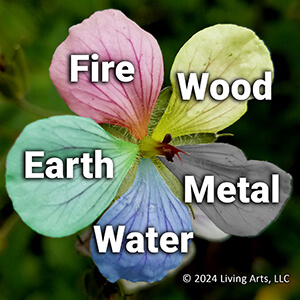
In the Vedic tradition, the five elements of nature are earth, water, fire, air, and ether. The four petals of the root chakra symbol relate to the first four elements. These are the four physical elements. Ether is not depicted because it is in the spiritual realm, and therefore invisible.
Using the Five Element System
Every aspect of life can be categorized according to one or more of the five elements. For example, mantras can accelerate the energy of one of the five elements. The five element system is a powerful way to view the world and the process of transformation. Many traditional cultures categorize various aspects of life according to a system of natural elements.
Natural Element Compatibility
Natural element systems describe the relationship between different energies and phenomena in the world around us. Finding your natural element compatibility can help you to choose the mantras that are the most supportive and healing for you. Learn more in the article Five Element Mantras.
Lotus Petals as Energy Channels
The four lotus petals also represent the connection between the energy channels in the body called “nadis” and the root chakra. The nadis carry prana or life force. The word “nadi” means “flow” or “current.” These energies run through the body on multiple levels: physical, subtle and causal. The nadis each have associated Sanskrit syllables: वं (vaṃ), शं (śaṃ), षं (ṣaṃ), and सं (saṃ).
Root Chakra Symbol: Circle Meaning
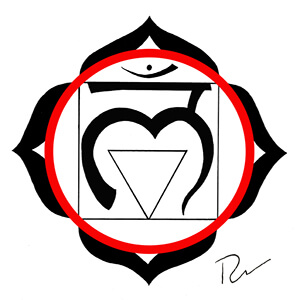
The circle is the most fundamental of all forms, symbolizing infinite space and expansiveness. The circle is present in all physical matter from the atom to planetary bodies. The circle symbolizes the central quest of spirituality: to realize oneness with all of creation. In terms of the root chakra symbol, the circle holds the four lotus petals together and encompasses the other inner symbols.
Metaphor of the Circle
A circle represents totality and wholeness. The circle is a metaphor for the family, social unit, or the sphere in which an individual dwells. Children begin to draw full circles around the age of three. Even earlier than that, they draw a circle with legs attached to represent people: mother, father, teacher, siblings, relatives and others. Learn more about circles in the article on Sacred Geometry.
Circles and Chakra Symbols
Likewise, the circle represents the sphere in which we all dwell as adults. The circle is a central aspect of the root chakra symbol as well as the other six chakra symbols. The circle creates an enclosed space. Identifying issues with the flow of energy in the root chakra is generally thought to be an appropriate first step towards spiritual acceleration.
Root Chakra Symbol: Crescent Moon Meaning
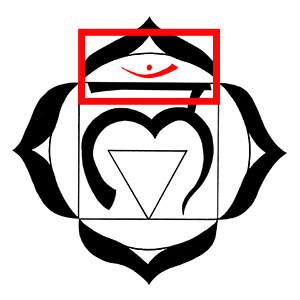
In the upper area of the root chakra symbol is a white crescent moon. This represents water energy and the emotions. The unconscious, connected to all the three of the lower chakras, is also sometimes symbolized as the ocean. Oceans symbolize the source of life and abundance.
Ocean Symbolism in the Root Chakra Symbol
In addition, oceans are constantly changing. This symbolizes limitless opportunities and possibilities. The ocean also represents our emotional world. Evolutionists believe that all of life originated in the sea. As Walt Whitman wrote in his work Leaves of Grass, the ocean is “the cradle endlessly rocking,” or the birthplace of all life. learn more about ocean symbolism in Nature Symbols & Spiritual Meaning.
Moon Symbolism in the Root Chakra Symbol
In Hinduism, the moon is seen as a source of light protecting individuals in the darkness of the night. All forms of light are welcomed, including the secondary light of the moon. The moon is associated with the god known as Chandra. The name Chandra means “bright and shining” in Sanskrit. The moon in Vedic astrology represents the mind, including thoughts, feelings, and psychology.
Watch nearly 300 videos on our YouTube channel!
Symbolic Meaning of the Sun and Moon
The light of the sun is steady and bright. On the other hand, the light of the moon is unstable, waxing, and waning through the month. Thus, the moon symbolizes the cycles of life while the sun symbolizes the fundamental energy of life.
Moon Symbolism and Human Emotions
The moon is closely associated with human emotions and the water element. For example, dreams of the moon are typically related to intuition or that which is hidden. This can be a positive association such as hidden talents.
Light of the Moon as Wealth
The light of the moon is also associated with abundance. Moonlight is softer than the light of the sun, more like splendor than brilliance. When the moon shines brightly, all is peaceful. The light of the moon can be a guide in the darkest of nights.
Power of Rebirth in the Root Chakra Symbol
The moon can also represent anything which has a strong pull, reflected in the way that the moon affect ocean tides. Ultimately, the moon represents the power of rebirth. More about the symbolism of the moon, the sun and other planetary bodies can be found in the article on Astrological Mantras.

Bindu (Dot) in the Root Chakra Symbol
The dot above the crescent moon is the bindu, a term which simply means “point” or “dot.” Similarly, the dot often applied to the center of the forehead between the eyebrows in the East is called the “bindi.” This is the feminine version of the word. The bindu is the point of both creation and unity. The bindi symbolically represents the bindu.
Male and Female in the Bindu Point
The dot in the root chakra symbol references both the bindu and the third eye. This is the place of spiritual vision or insight. Bindu encompasses both the masculine and feminine, Shiva and Shakti respectively. Most yantras and other sacred symbols including all seven of the chakra symbols contain the bindu as part of their sacred design.
Root Chakra Symbol: Square Base
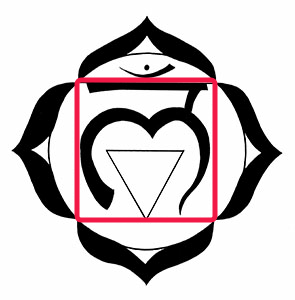
The central square in the root chakra symbol is a metaphor for stability. The root chakra provides the foundation upon which the other chakras rest. As noted above, the root chakra can also be seen as connected to your personal and ancestral history. The root chakra symbol is the only chakra symbol featuring a prominent square. The numerical equivalent for a square, of course, is four.
Sacred Geometry and the Square
The square represents the four cardinal directions in sacred geometry symbols. A square symbolizes the foundation or base of the material world. Chakra symbols are a type of yantra. Yantras are complex sacred symbols similar to mandalas. Each yantra has multiple components with layers of meaning. Most yantras have a square as their fundamental form. Learn more about Yantra Symbol Meaning.
Square Symbolism: Balance and Strength
The root chakra can either bind you to the earth in a negative sense or give you a strong base and presence in the world in the positive sense. The square connects to the earth element in the five element Vedic tradition (earth, water, fire, space, air). A balanced and strong root chakra affords the ability to stand your ground and feel safe in the world.
Root Chakra Symbol: Sanskrit Character
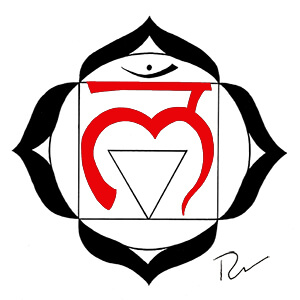
The Sanskrit character in the center of root chakra symbols represents the syllable LAM. This is the bija or seed syllable for this chakra. This sound (pronounced LUHM and sometimes LUNG) can activate and balance the root chakra. This seed syllable can be used in mantras and sacred toning. Sacred toning is vocalization on a single syllable, usually composed of varying vowel sounds. Learn more about the bija seed syllables in the article Chakra Sounds.
Letter “L” and the Power of Semi-Vowels
At an even deeper level, every letter in the Sanskrit alphabet carries a specific vibration. For example, in the sound LAM, the initial “L” is a semi-vowel. This means that the “L” sound can be extended to a certain degree, though not as long as a an open vowel (A, E, I, O, U). The longer the sound can be held, the more physical the effect. The absence of sound (silence) remains in the spiritual realm.
Semi-Vowels and Natural Elements
Semi-vowels are connected to the four elements of nature (earth, water, fire and air) because they are halfway between the physical realm and the spiritual realm. From this perspective, LAM is a sound connected to the earth element. The sound “L” is also associated with joy, creativity and femininity. This sound is connected to happiness and Lakshmi, the goddess of wealth. Learn more about Lakshmi in the articles Lakshmi Mantras and Shrim: Seed Syllable for Wealth.
Letter “A” and Vocal Chord Vibrations
The short “A” (pronounced UH) in the middle of the seed syllable LAM is the most primal of all sounds. This is the fundamental or root vibration of the vocal chords, the most basic opening necessary to produce sound. Thus, this sound is an affirmation of life and the exhalation of breath.
Letter “M” and the Divine Mother
The final “M” represents dissolution and transformation. The sound “M” is generally associated with the Divine Mother in Her many forms. The letter “M” also has a nourishing quality. “M” initiates the word for Mother in many languages: Mother, Mama, Mom, Mor, Ma, Madre, Mater, Mata, etc.
Triangle Meaning in the Root Chakra Symbol
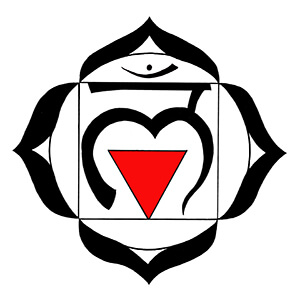
The upside-down triangle is an alchemical symbol for water and feminine energy. The triangle in the center of the root chakra symbol is balancing the earth energy of the larger square in which it resides. The triangle is the primary form that can enclose space within straight lines. Thus, the triangle is viewed as the first form to emerge from chaos.
Polarity of the Root Chakra
The fundamental polarity of the root chakra is feminine. The kundalini energy that is coiled in the root is seen as the energy of the Divine Mother or the universal Goddess. This energy is drawn to the masculine energy of spirit in the higher chakras and the crown chakra.
Root Chakra Symbol in Life and Health
If the energy in the root chakra is blocked, several issues may arise. On the emotional level, you may feel depressed or anxious. Since root chakra symbol meaning includes safety issues, you may be concerned about securing or retaining the basics in life. For example, if you are worried about basics like paying the rent, you may not be inspired to strive for higher ideals or aims.
Symptoms of a Blocked Root Chakra
On the physical level, you may have problems with constipation (lack of release) or difficulty with basic functions of the lower body such as walking. You may literally have difficulty moving forward. Problems with the hips and knees may also be related to unbalanced or inadequate energy in the root chakra.
Need for Root Chakra Grounding
If you do not have solid grounding in the root chakra, you may feel paralyzed on multiple levels. For instance, if you are not rooted through this chakra, you may jump from task to task without making progress in any one direction. In addition, when the root chakra energy is not flowing, you may feel chronically tired.
Download artwork on our FREE STUFF page!
Impact of World Events on the Root Chakra
The root chakra is affected by any events that threaten basic security in life: wars, natural disasters, political upheaval, and so forth. Events that have the potential to literally uproot your life will be felt as a disturbance in root chakra energy. Mastering the root chakra involves learning to find the needed strength and resources within yourself as a key survival skill.
Experiencing Root Chakra Flow
When the root chakra is aligned and the energy is unlocked, your sense of comfort in the world will increase. You’ll feel calm and steady. You’ll be able to establish and work towards personal goals. You will literally feel grounded. Practices that help to heal and balance this chakra include yoga, mantras, affirmations, meditation, visualization, breathing techniques, and release (forgiveness).
Click to explore a related article on this website!
Root Chakra & Associated Organs
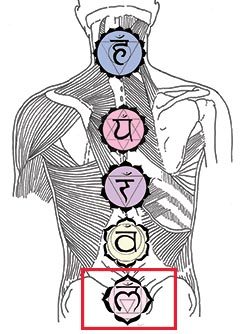
The root chakra is located between the perineum and lower spine. Each of the organs in the human body are associated with one or more of the seven major chakras or energy centers. This aspect of the root chakra reveals keys to creating optimal health on both energetic and physical levels. The root chakra governs the lower part of the body, including the legs, hips, knees, lower back, pelvis, organs of elimination (bladder and colon), and the lower spine.
Creating a Physical Foundation for Life
These areas of the body establish balance and stability. These are the organs and systems that provide a strong foundation for physical health and a platform for our presence in the world. There is some overlap between the organs and glands associated with the root chakra and the sacral chakra. However, the sacral chakra is more closely connected to reproduction while the base chakra relates more directly to elimination.
Physical and Symbolic Links to Health
Root chakra symbol meaning also includes the psychological patterns connected to the nearby physical organs and functions. Understanding these energetic and physical links can help you to identify areas that need support in your life. The following are some of the symbolic links between the human body and root chakra meaning.

Click to explore a related article on this website!
Legs and the Root Chakra
Your legs take you in the direction you want to go! Problems with the legs may indicate a conflict related to choosing a path in life. Legs give you the ability to run, dance and stand. To slip and fall indicates a lack of grounding through the root chakra.
Ankles and Root Chakra Meaning
Ankles are related to support, a central theme for understanding root chakra meaning. Building a support system within and without (family, friends, employment) will put you in a position to grow on other levels. Your own ideals and principles also create a structure of support. Ankles also have to do with flexibility and accepting pleasure in life.
Hips and Root Chakra Symbolism
A broken hip can be caused by a loss of support or the desire to lean on someone else awhile. You may be resisting forward movement in life. Hips are literally a pivotal place in the body. Major changes in life such as moving to a new home, losing a loved one or changing careers may be reflected in the health of the hips. These issues are integral to the energy of the root chakra.
Lower Back and Root Chakra Meaning
The lower back is connected primarily to finances. When you are stressed financially, the chances that lower back problems will develop is increased. In contrast with this, the middle back is often connected to issues of love and relationships.
Upper Back, Shoulders and the Root Chakra
The upper back often reflects the burdens you are bearing in life. This area of the body is literally your “backbone.” The stability needed here is represented by the square in the root chakra symbol. Keep in mind that the ability to face life is the ability to “square” your shoulders.
Download artwork on our FREE STUFF page!
Bladder and the Root Chakra
The bladder has the amazing ability to grow and shrink as needed to hold the capacity of urine required at any given time. This adaptability is a key identifying trait. Likewise, the ability to remain grounded in changing circumstances is a skill related to the meaning of the root chakra symbol.
Colon and Root Chakra Meaning
Problems with constipation or more serious colon issues can be related to an inability to let go of the past. Refusing to let go of your position or opinion can also be an unhealthy pattern that shows up as intestinal disturbances. Constant worry or being stuck in loops of concern can also affect the colon and indicate a lack of energy flow in the root chakra.
Lower Spine and Root Chakra Symbolism
The lower spine may be affected if you doubt your ability to support yourself. This can also be a larger sense: you doubt that life itself will support you. In a concrete way, this often boils down to finances. Many back problems are muscular rather than spinal. The need to deeply relax may help to establish a healthier flow of energy through the root chakra and lower spine.

Click to explore a related article on this website!
Root Chakra & Kundalini Energy
Many mystics and yogis have written and taught about the rising of the kundalini. The kundalini is often symbolized as a coiled snake at the base of the spine. This is the origin of the caduceus symbol in the medical industry.
Kundalini Movement through the Chakras
As the kundalini moves upward, the energy flows through the seven major energy centers or chakras. In some meditation practices, bringing the energy to the crown of the head is considered to be the physical counterpart to achieving enlightenment.
Kundalini Goddess & the Root Chakra
Of course, there are mystics who have achieved elevated states without any knowledge of such things. You do not necessarily have to know chakra definitions or the details of the kundalini to meditate, practice yoga, or sing mantras. In the East, the kundalini energy is personified as the goddess Kundalini. See information below on Hindu gods and goddesses linked to the root chakra.
Awakening the Kundalini
All the same, if you want to cultivate this process consciously or you are seeking to understand spontaneous experiences, familiarity with these things could be helpful. There are many approaches to awakening and raising the kundalini.
A wide variety of yogic techniques can guide you in that direction. In fact, even rather mechanical practices can be effective. For example, Dr. Francis Lefebure, a French physician and scientist (1916-1988), designed a device called a Gyrascope that would awaken the kundalini when used for about an hour a day.
Rotational Force and the Root Chakra
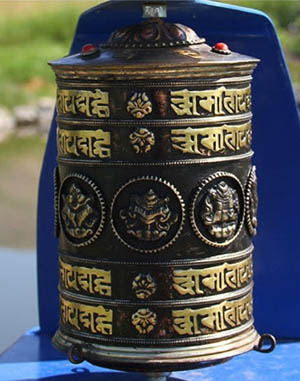
The whirling dervishes of the Sufi religion and Tibetan prayer wheels are based on the principle that rotational force results in energy rising upward. Interestingly, children often play a game of spinning around until they are too dizzy to stand up. As adults, we are generally moving only forwards or backwards! The root chakra as well as the other chakras can be visualized as spinning wheels.

Click to explore a related article on this website!
Author’s Story: A Spontaneous Kundalini Experience
I had an unexpected experience of the power of the root chakra several years ago. I was taking a swing dance class with my husband. He was enthusiastic about having me there. He was an avid ballroom dancer at the time. I was less keen on attending. However, I had agreed to go as a shared activity.
Learning the Dance
There were twenty or thirty people in the class and the men were lined up in a circle around the edge of the room. The women would dance with one man for a moment or two, practicing a variety of spinning moves, and then move on to the next man and repeat the same steps and spins.
Kundalini Rising
We were nearing the end of the hour. Since we were repeating the same spins over and over, we were actually whirling around much more than one normally would in an actual dance. Suddenly I felt a rushing sense like a campfire ignited at the base of my spine, instantaneously filling my pelvis and beginning to move upwards.
Root Chakra Energy
I had never experienced that kind of thing before but had read and studied enough to recognize what was happening. I knew it had something to do with the kundalini energy at the base of the spine in the root chakra beginning to rise. However, I had no clue what would happen next.
Starting to Panic
I was panicked about being in a public place during this unusual experience. Was I going to have a seizure? Would I fall to the floor twitching and writhing and humiliate myself? Would I lose consciousness? Would they have to call an ambulance for me?
Ending the Experience
“No!” I commanded instantly, “Not here! Not now!” The experience ended as quickly as it had begun. I walked to the foyer, changed my shoes and headed for the car. To my husband’s disappointment, I refused to take any more dance classes. Going forward, I preferred to work with the chakras in a more conscious and controlled manner.
Watch nearly 300 videos on our YouTube channel!
Root Chakra Mantras
Simple chakra mantras can be created using the bija seed syllables for each chakra. These syllables reflect the essence of each chakra and help to clear and strengthen the associated energy. Creating a mantra with these sounds helps to soften their effect and make the sounds easier to repeat over an extended period of time such as ten minutes per day.
The Meaning of OM
Typically, mantras begin with the sound OM. The Sanskrit word OM is familiar to most people. OM is the sound of the universe, the sound from which all other sounds are formed. After OM, chakra mantras contain the seed syllable for the intended chakra. Finally, chakra mantras close with the word “Namaha.” This word is usually translated as “I bow,” “I give reverence” or “I honor.”
Root Chakra Mantra
Using the above formula for creating mantras for the chakras (“OM” followed by the chakra seed syllable and ending with “Namaha”), a simple mantra for the root chakra would be “OM LAM Namaha.” The seed syllable for the root chakra LAM is pronounced “luhm”. This mantra can be translated as, “I give honor to the energy of the root chakra.”
Vowel Sounds & the Root Chakra Symbol
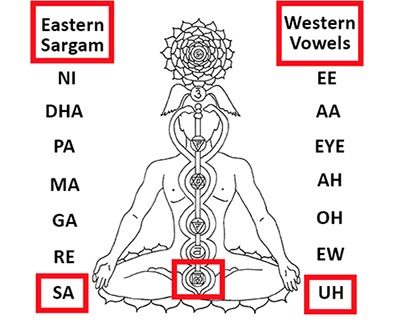
As noted above, the root chakra symbol contains the Sanskrit symbol for the syllable LAM. In the West, there are vowel sounds associated with each chakra. The vowel sound for the root chakra is UH. In the Sanskrit musical system called sargam, the sound associated with the root chakra is SA (SAH). In addition, the musical instrument associated with the root chakra is the drum. Learn more in the article Chakra Toning & Vowels.
Drums and Root Chakra Meaning
The drum establishes the foundation and rhythm for music. This is similar to the role of the root chakra: creating a base for all of the other chakras. Learn more about the sounds and mantras for all of the chakras in the article Chakra Sounds.

Root Chakra Note & Frequencies
Chakras and musical notes have been paired in a number of ways. A simple system is to assign sequential notes from the C Major scale to each of the chakras from the root to the crown: C (root), D (sacral), E (solar plexus), F (heart), G (throat chakra), A (third eye) and B (crown chakra). However, the science of sound goes even deeper than this basic parallel construction.
Determining Chakra Frequencies
The sound frequencies associated with each chakra are measured in hertz (HZ). Hertz are the cycles per second of a sound wave. Some say that the ratio of frequencies is more important than an exact pairing of chakras and musical notes. For example, the exact frequencies may be affected by the size of the individual, though the proportions or ratios from chakra to chakra may remain the same.
System of Chakra Musical Tones
Note that the assignment of frequencies to the chakras can be a controversial undertaking. This is definitely a field where additional research and study may be warranted. One possible system of frequencies is given below starting on the note A at 432HZ.
- Root Chakra 432HZ
- Sacral Chakra 480HZ
- Solar Plexus Chakra 528HZ
- Heart Chakra 594HZ
- Throat Chakra 672HZ
- Third Eye Chakra 720HZ
- Crown Chakra 768HZ

Essential Oils for the Root Chakra
Essential oils have an ancient history of use in religious rituals as well as for medicinal purposes. Essential oils are volatile, meaning they evaporate easily. They also affect into the sense of smell, which is part of the limbic system.
Role of the Limbic System
The limbic system is where memories and emotions are often stored in the brain. Imbalances in the root chakra can appear as anxiety disorders, nightmares, and fears about safety and security. A strong root chakra is also important for the health of the colon, bladder, lower back, legs and feet.
Recommended Oils for the Root Chakra
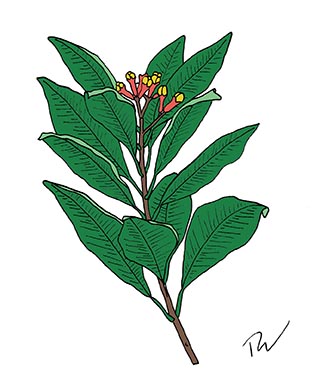
Although recommendations may vary, the following essential oils are generally associated with helping to balance and heal the root chakra. These oils can be diffused or used in conjunction with chanting, meditation, affirmations or prayer. Or learn more about essential oils for all of the chakras on this website in the article Chakras and Essential Oils. Essential oils for the root chakra include:
- Clove creates warmth and familiarity, dispelling fears
- Rosemary energizes the environment and assists with mental and emotional clarity
- Cypress stimulates ease, assists in the removal of mental blocks
- Black Pepper soothes anxiety
- Vetiver dispels negativity and restlessness
RELATED ARTICLE: Chakra Stones and Crystals
Root Chakra Healing Stones
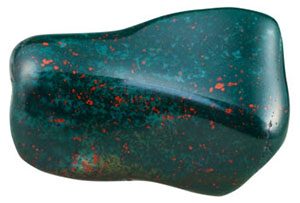
Stones believed to positively influence the root chakra are Bloodstone, Jasper and Red Coral. Other stones connected to root chakra meaning and function are Carnelian, Tiger’s Eye and Obsidian. Bloodstone is a specific form of Jasper, originally called the Sun Stone and later Christ’s Stone, symbolizing the blood of Christ. In other traditions, this stone is associated more generally with blood as the fundamental energy of life.
Bloodstone and Root Chakra Meaning
Bloodstone represents vitality, passion and courage. These characteristics relate directly to positive root chakra meanings. This stone’s connection to blood purification dates back five thousand years to Mesopotamia. According to folk medicine, bloodstone is particularly valued as a means to stop the flow of blood and to heal any wound.
Red Coral and Root Chakra Symbolism
Red Coral is technically not a gemstone, but it was used extensively in ancient civilizations for medicinal purposes. Like its sister from the sea, the pearl, this stone is comprised mostly of calcium. Red Coral is purported to enhance fertility, calm the mind, and strengthen the skeleton. Red coral is grounding for the root chakra, helping to focus energy on the completion of goals and projects. Red Coral is the stone of optimism, bringing good luck and pleasant dreams.
Rubies for the Root Chakra
Rubies are the birthstone for the month of July. Rubies are one of the four most precious gems: emerald, sapphire, diamonds and rubies. The red color of rubies comes from trace amounts of chromium. Rubies symbolize power and protection. Rubies were believed to protect warriors in battle. According to folklore, rubies also help their possessor to be at peace with their enemies.
Download artwork on our FREE STUFF page!
Root Chakra Gods & Goddesses
The deities Indra, Brahma and Ganesha are associated with the root chakra. On the feminine side, the forms of the deity associated with the root chakra are the goddesses Dakini and Kundalini. These deities correlate directly with root chakra meaning: their qualities help to establish a foundation for the higher chakras. Learn more in Chakra Gods and Goddesses.
The God Indra and the Root Chakra
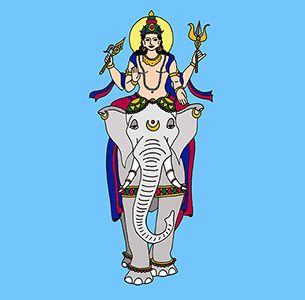
Indra is the king of heaven. He is associated with lighting, thunder, storms, rain and rivers. Indra rides on an elephant, symbolizing compassion, intelligence, and ancient wisdom. Indra’s weapons include the thunderbolt and the trident. Indra holds a thunderbolt (vajra) in one hand and a trident (threefold spear) in the other. The thunderbolt cleaves through ignorance, dividing the real from the unreal. The trident represents three divine powers: will, knowledge, and action.
Brahma and Root Chakra Meaning
Brahma is the Hindu creator god also known as the Self Born, the Lord of Speech, and the creator of the four Vedas. Brahma is the consort of Saraswati, the goddess of knowledge and wisdom. Brahma is traditionally depicted with four faces and four arms. Each of Brahma’s four faces point to a cardinal direction. His hands hold symbols of knowledge: sacred texts, mala beads, a ladle, and a lotus.
Ganesha and the Root Chakra
Ganesha, a beloved elephant-headed Hindu god, is another prominent figure connected to the root or base chakra. Ganesha is often invoked at the beginning of an undertaking or an event. This connects directly to the root chakra as the origin of the kundalini energy flowing to the upper chakras.
Ganesha is the patron of writers and learning. He is also known as Ganapati. In Hindu mythology, Ganesha is the son of the goddess Parvati and the god Shiva. Ganesha has extensive symbolim related to his ears, clothing, feet, trunk and more. Learn about this beloved deity in Ganesha Meaning.
Watch nearly 300 videos on our YouTube channel!
The Goddess Dakini and the Root Chakra
Dakini represents the divine potential for life. Dakini is often viewed as possessing a dual principle: the capability for both good and evil. Forms and references to Dakini varies from tradition to tradition.
The Goddess Kundalini
The kundalini energy has been personified as a goddess in many different forms. The Goddess Kundalini is sometimes called Adi Parashakti. This literally means the “first and highest feminine energy.” Another goddess associated strongly with the kundalini energy is Durga. Learn more about Durga the Warrior Goddess.
Download artwork on our FREE STUFF page!
Symbolic Flowers & Root Chakra Meaning
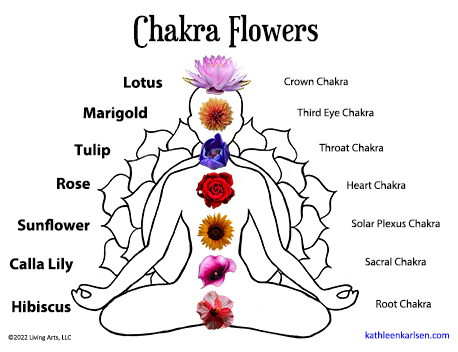
The root chakra is often associated with the color red. Poppies, peonies and poinsettia are clear favorites as symbolic flowers for the root or base chakra. However, in a purified state, the root chakra is thought to be white. Thus, white flowers can also symbolize the root chakra. Most significantly, the lotus flower is a significant part of the root chakra symbol itself as discussed above.
Root Chakra Symbol & Lotus Flowers
Lotus flowers serve as a symbol of spiritual enlightenment. They mean purity, rebirth and divinity. As a consequence, the lotus is the national flower of India. Additionally, the blue lotus is the sacred water-lily of Hinduism and Buddhism. Negative meanings for the lotus are estranged love and forgetfulness. In addition, lotus roots are used widely in Asian cooking.
Root Chakra Flower Symbolism
Since the root chakra also creates the base for all of the other chakras, flowers that have a strong root system are ideal choices as root chakra flowers. Thus, some root chakra flowers such as hibiscus and begonia grow on shrubs, bushes or trees. Learn more about the unique symbolic meanings of root chakra flowers and flowers for all of the chakras in the article Chakra Flowers.
Hibiscus Flowers and the Goddess Kali
Hibiscus flowers are sacred to the goddess Kali. Kali is a fierce Hindu goddess who symbolizes primal energy. Kali is a demon-slayer. She protects her devotees from attacks and negative influences. She defends their right to pursue spiritual practices. Hibiscus flowers are orange, yellow, red and pink.
Begonias and Root Chakra Meaning
Begonias are a solid, strong flower. They are often white, pink or scarlet. Some view white as the color of the purified root chakra. Begonias grow in shrubs rather than on individual stems. Begonias are sometimes given as gifts to celebrate major accomplishments. This includes events like graduations and anniversaries.
Poppies Meaning Death and Eternal Life
Poppy flower meanings are beauty, magic, fertility and eternal life. For this reason, the Egyptians included poppies as a sacred flower at funerals and in burial tombs. Thus, poppies are related to both eternal life and to death. Poppies also symbolize both prosperity and humility. Having a strong financial foundation is a key. When the basics are available, this provides the freedom needed to pursue spiritual practices. Read full article on Poppy Flower Meaning.
Peonies for Wealth and Security
Peonies are another beautiful flower that is usually pink, red or white and grows on a sturdy bush. They are appreciated worldwide for their large, scented flowers. Peonies signify wealth and prosperity. Peonies are also symbolic of romance and a happy marriage. The name comes from a Greek myth in which Zeus brought a young man named Paean back to life and transformed him into a flower.
Click to explore a related article on this website!

Root Chakra & Chakras of the Earth
The chakras of the earth have similar meanings and functions as the chakras in the human body. Most of the earth’s chakras are on energy lines called ley lines. These are electromagnetic lines that are purported to hold significant power.
Root Chakra Geographic Location
The root chakra is believed to be located in California in the United States. Some say that the focus is in Mount Shasta, others see San Francisco or Los Angeles as the epicenter of this energy. Mount Shasta is long-known as a place of mystery, UFO sightings and reported encounters with advanced beings.
Location of Other Earth Chakras
There are differing opinions on the location of the earth’s chakras. One possibility is that the other earth chakras are located as follows: Sacral Chakra-Lake Titicaca, South America; Solar Plexus Chakra-Uluru & Kata Tjuta, Australia; Heart Chakra- Glastonbury, England; Throat Chakra-Giza, Egypt; Third Eye-also Glastonbury; and Crown chakra-Mount Kailash, Tibet.

Practical Tips for the Root Chakra
Practical approaches to strengthening and healing the root chakra include eating a balanced diet, have an active lifestyle (including some form of stretching or yoga), and consciously increasing energy flow in the physical body.
Healthy Foods for the Root Chakra
Foods with high fiber are recommended for the health of the large intestines, one of the primary organs related to the root chakra. Interestingly, this includes root vegetables such as carrots, beets, turnips and parsnips.
Root Chakra Mudra
Mudras are hand positions that help to direct energy through the acupuncture meridians ending in the fingers. The root chakra mudra involves touching the third finger to the thumb. This is called the “Muladhara Mudra.”
Yoga Poses for the Root Chakra
Yoga poses for the root chakra can restore balance and stimulate proper energy flow. Specific yoga poses that are beneficial for the root chakra are Sun Salutations (Surya Namaskara), the Corpse Pose (Shavasana), Child’s Pose (Shashankasana), Half Bridge Pose (Ardha Setu Bandhasana), Standing Forward Bend (Uttanasana), and Warrior II (Virabhadrasana II).
Root Chakra Symbol Video Shorts
Root Chakra Affirmations
Affirmations can be used to create a strong foundation in your life. Choose affirmations that fit your situation and try using them for at least a few minutes a day until you are satisfied with the results. I think you’ll be so excited about the shifts in your life that you will want to continue using these or other affirmations indefinitely.
The Purpose of Root Chakra Affirmations
Root chakra affirmations are a powerful way to create safety and security in your world. Learn to ground yourself and gain healing release with affirmations! Use the affirmations below as part of your self-care practices. Root chakra affirmations emphasize the bounty of the universe and the provision of basic needs such as community, food and shelter. You can meditate on them, write them out, speak them aloud, say them to yourself in a mirror or sing them in the shower!
Affirmations for Release
Stagnation in the root chakra can be connected to possessiveness. This might be allowing others to possess and control you. This may also be your own possessiveness or selfishness towards others. You may feel that others need your help. Be careful not to try and control others through your assistance. A final form of possessiveness is unconscious attachment.
Energy Flow in the Lower Body
Attempts to dominate others can be a mental block to healthy intestinal functioning. Proper energy flow in this area help to maintain a straight back and a balanced, flexible lower body. Try the following root chakra affirmations for release and elimination:
RELEASE OF THE PAST
- The past is over. My personal and ancestral history is complete.
- The memories of the past are dissolved and released through the power of God within.
- I live in the joyful present.
- I no longer condemn myself or others.
- I hold fast to the good and cast out all regrets.
- I am filled with new life.
- I allow everyone to reign as sovereign in their own lives.
- I trust in the divine path of each soul. It is safe to let go and be free.
RELEASE OF POSSESSIVENESS
- The pure love of my higher self now dissolves all appearances of human selfishness.
- I am free of thoughts that clutter my mind and life.
- I now willingly let go of every thought, condition or relationship that delays my healing.
- I am blessed with healing release at every level of my being.
- I release you to your highest good as a child of God. I let you find your own life and path.
- I give everyone the freedom to grow and change.
Root Chakra Affirmations for Safety
Overemphasis of the mind versus gut level feelings can result in lack of vitality and flow in the abdominal region. Challenges including constipation may result. If purely personal objectives are prioritized consistently over service to others, this may also result in a blockage in the energy of the root chakra. Fear of loss or concern about safety and security are also root chakra issues.
Root Chakra and the Sense of Lack
An imbalanced root chakra can be connected to the feeling of lack. This may be a lack of material goods or the fear of want. The fear of material loss is also part of this mental pattern. You may have a sense of a lack of time and having too much to do. Constantly pushing and striving rather than relaxing can also create stress at this level. Try experimenting with the following root chakra affirmations:
SAFETY & SECURITY
- The power of God within me now guards and protects my life.
- The spirit of Life within me is the unlimited power working for balance and peace.
- I create a safe new future for myself.
FREEDOM
- I relax and let Life flow joyously. I am free.
- I am free of all thoughts of bitterness, revenge, intolerance, injustice and misunderstanding.
- All of my thoughts bring new life, happy relationships and a healthy body.
- I soften and sweeten my thoughts towards those around me.
- I dwell on the good in everyone.
- Forgiveness stimulates my body and soul.
- My mind and emotions choose freedom and joy.
- I let go and let freedom reign is all of my relationships now.
- I trust in the God within each one.
Root Chakra Affirmations & Physical Health
The feet literally represent our understanding in life. The lower body symbolizes moving forward, activity and new directions. This includes the feet, toes (details of life), ankles, lower back, pelvis, toes and knees. The muscular and skeletal systems are also governed by the root chakra. These systems provide a foundation for the structure and strength of the entire body.
MOVING FORWARD
- I give myself permission to move forward in life.
- It is safe to find new directions and paths.
- I step forward with freedom and joy.
- I approve of my new direction in life.
- I welcome the changes that bring lightness, freedom and sweetness into my life.
- I release all attitudes, experiences and relationships that do not contribute to my freedom and harmony now.
KNEES & FLEXIBILITY
- I live in compassion and forgiveness.
- I am flexible and flowing.
- I bend humbly with the Divine Intelligence and trust that all is well.
- I carry the sacred flame within in honor and appreciation of life.
- I release all that does not contribute to my health and core identity.
- I govern the thoughts of my mind. My character is straight and upright.
AFFIRMATION FOR THE TOES
- The details of the future are arranged in perfect order.
MUSCULAR SYSTEM
- I am filled with the strength, power and vitality to accomplish all that I desire.
- I am free from all mental and emotional weakness.
- My strength is my conviction of the goodness of life.
- There is no strength or power except the good.
SKELETAL SYSTEM
- I am the authority in my world.
- I create a strong and balanced structure to support myself.
- I am in charge of my mind, body and life.
AFFIRMATIONS FOR DIVINE ORDER
- Divine order is now established in me by the power of the indwelling Christ.
- Divine order is now established in my mind, body, relationships, finances and all life situations.
- I live in divine order! Every phase of my world is in divine order.
- Divine order heals, prospers and guides me now.
AFFIRMATIONS FOR HARMONY
- The inflow and outflow of everything in my life is established in divine order and harmony.
- I am peaceful and poised. I give thanks for divine order.
- Divine order brings me life sustenance, increased vitality, energy and healing power.
- Divine order expresses through me in freedom and joy.
- Divine order radiates into every area of my life.
Using the Root Chakra Symbol in Daily Life
To connect with the energy of the root chakra symbol, you may want to consider decorative items featuring the root chakra symbol. You could use artwork or jewelry for this purpose. Meditating on the root chakra symbol is another approach. Here are some ideas for using the root chakra symbol:
- Hang an illustration of the root chakra symbol in an area where you meditate or chant
- Find a painting of a lotus flower featuring four petals prominently
- Choose a necklace or bracelet with the root chakra symbol
- Use a keychain that incorporates the root chakra symbol
- Use housewares such as coffee mugs or pillows with the root chakra symbol
More Chakra Symbol Resources
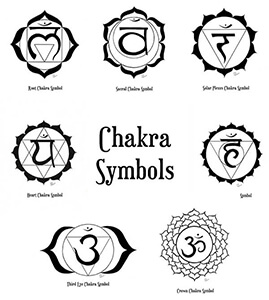
Sacral Chakra Symbol Meaning: The sacral chakra is known in Sanskrit as Svadhishthana, meaning literally “one’s own place.” Sometimes the sacral chakra is called the seat of the soul. Another sacral chakra meaning relates to housing the unconscious.
Solar Plexus Chakra Symbol Meaning: The solar plexus chakra is located at the naval, center of intuition (a gut feeling). This chakra is connected to both service and desires. This is the chakra where we get a gut feeling about people, places and events.
Heart Chakra Symbol Meaning: The heart chakra is the seat of love and devotion. In a balanced and healthy state, the heart expresses charity, compassion, and kindness. In addition, the heart is a focus for beauty and culture.
Throat Chakra Symbol Meaning: The fifth chakra is the throat chakra or the Vishuddha chakra. In Sanskrit, Vishuddha means “especially pure.” The throat chakra is depicted as having sixteen petals. In the center is a triangle pointing downward and a white circle representing akashi or ether.
Third Eye Chakra Symbol Meaning: The sixth chakra is the third eye chakra, the seat of spiritual vision. The fundamental meaning of the third eye is intuition and visualization. For this reason, the third eye is associated with heightened perception and insight.
Crown Chakra Symbol Meaning: The seventh chakra is the crown chakra, the seat of enlightenment, known in Sanskrit as the Sahasrara chakra, meaning “thousand-petaled.” According to Eastern traditions, the crown chakra is related to god-consciousness (samadhi) and the transforming powers of the divine.

Author Kathleen Karlsen
Kathleen Karlsen is a musician, artist, writer and speaker. She is the author of two books (Flower Symbols and Vocal Medicine) and over 200 articles. Kathleen, her husband Andrew, and their five children live in Bozeman, Montana. More about Kathleen Karlsen.

ROOT CHAKRA SYMBOL ARTICLE SUMMARY
The root chakra establishes a connection to the physical body, the earth, and the environment. This is a place of security and safety. The root chakra symbol is a visual map of the significance of this chakra. This article on the root chakra symbol also includes information about related aspects of sacred geometry, Vedic astrology, root chakra sounds, essential oils, healing stones, associated deities, and the physical organs near the root chakra.