

Sacred Symbols > Yantras > Surya Yantra
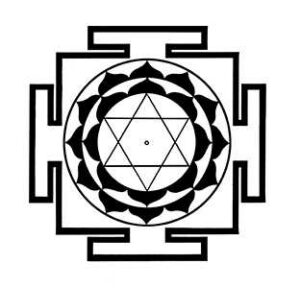
Surya Yantra
by Kathleen Karlsen, Author of Vocal Medicine
The Surya Yantra is sometimes called the Radiance Yantra. The twelve outer petals are known as the celestial beams of the sun. They are symbolic of the twelve months of the year and the twelve astrological signs. The sun is the regal master of the entire solar system and the visible universe.
Benefits of the Sun Yantra
Focusing on the Surya Yantra can be particularly appropriate for extending yourself into new social situations, travel or undertaking adventures in life. Surya is a celebration of light and illumination in yourself and others. When colored, the Surya Yantra is decorated with flaming red, orange, silver and gold.
Mantra to the Sun
The mantra associated with the Surya Yantra is “Om Hram Hrim Hraum Sah Suryay Namaha.” As the god of the sun, Surya brings illumination, healing and spiritual magnetism. The yantra and the mantra are both tools for guiding the thoughts and feelings in healthy patterns, but the viewer’s intention is paramount.
RESOURCE: Learn more in the article on the Surya Mantra.
Symbolism of the Surya Yantra
Most yantras have a square as their fundamental form. The numerical equivalent, of course, is four. The square connects to the earth element in the Vedic tradition. The square is also the base for the root chakra symbol. Learn more in Chakra Symbols. The Surya Yantra also possesses squares, circles, triangles and lotus petals. We’ll look at the meaning of each of these elements.
Gates Into the Surya Yantra
On each side of the Surya Yantra are gates that open up to invite the viewer into the center of the yantra. There are four doorways or gates protruding from the square at the circumference of the yantra. These gates are thresholds between the inner and outer worlds. The Surya Yantra can be viewed as a map of man’s spiritual journey from the outer to the inner along designated circuits.
Circle Meaning and the Sun
The circle is repeated three times in this yantra, representing the cycles of nature guided by the sun and the expansiveness of the universe. The mantra associated with the Surya Yantra is “Om Hram Hrim Hraum Saha Suryaya Namaha.” As the god of the sun, Surya brings illumination, healing and spiritual magnetism.
Lotus Flower Petal Meaning
The lotus symbolizes purity, enlightenment and transcendence. In a yantra, the lotus is usually viewed from the top, with the petals extending out on the rim of a circle. Metaphorically, the lotus illustrates the unfolding of the divine essence within. The Surya Yantra features two rings of lotus petals. The inner ring has eight petals. The outer ring has twelve petals. As noted above, the twelve petals correspond to the twelve signs of the zodiac and twelve months of the year.
Inner Ring of Eight Petals
The inner ring of eight lotus petals in the Sri Yantra each have their own symbolism. The petals represent siddhis or yogic powers. Specific deities embody each of these powers. These are sometimes viewed as specific human activities: speech, motion, grasping, revulsion, enjoyment, attraction, equanimity and excretion.
Mastering the Inner Petals
This inner circle is referred to as the “Agitator of All.” Mastering the qualities of each petal through meditation, self-observation, and individual effort can grant both worldly and spiritual success. The specific meaning of the petals can be outlined as follows.
Qualities of the Lotus Petals
ANIMA: This word means smallness or vulnerability. The siddhi or power conveyed is closely related to honesty with yourself and others. This is the ability to connect to yourself internally.
LAGHIMA: Laghima means bigness in the sense of taking the maximum amount of responsibility in your own life. This also conveys a connection to the largest self or the universe.
GARIMA: Garmina means heaviness, grounding, an anchor or a weight. This is a positive sense of being rooted to the earth, being unmoved by circumstances and sticking to your purpose.
MAHIMA: Mahima means creativity. This yogic power is a direct connection to a free flow of ideas and the resulting accomplishments.
EASATVA: Easatva means godliness and purity. This is the power of courage and confidence that comes from knowing you are pursuing your own highest calling in wisdom and love.
VASATVA: Vasatva means subjugation, bringing under control and conquering the self. This is the ability to overcome obstacles in life versus utilizing violence or overcoming others.
PRAAKAMYA: Praakamya means fulfilling the objective. This involves creating a strategy and a sense of conviction so strong that you feel that all that is necessary has already happened.
Triangles in the Surya Yantra
Each triangle contains within itself three points. These represent the three basic forces in the universe: creation (sattva), preservation (rajas) and dissolution (tamas). These points and processes relate to the Hindu Trinity of Brahma, Vishnu and Shiva. The Divine Mother (Shakti) is the force behind each of these that enlivens them and gives them power. The symbolism of the trinity is repeated in the three concentric circles of the Surya Yantra.
Downward Triangle in the Surya Yantra
A downward triangle is a symbol of the divine feminine. Downward triangles are connected to the water element. The easiest way to remember this is to think of a waterfall. In addition, water is related to the emotions. The word “emotion” can be interpreted as “energy in motion.”
Triangles and the Divine Feminine
Like water, feminine energy is free flowing and powerful. This energy is referred to as “shakti.” Downward triangles are specifically related to the Hindu goddesses Kali (Goddess of Time and Death), Parvati (Goddess of Fertility), Lalita (Goddess of Beauty), and Lakshmi (Goddess of Wealth).
Upward Triangle in the Surya Yantra
An upward triangle represents masculine energy and the element of fire. This shape can be seen in form of a campfire. In the Hindu tradition, an upward triangle is particularly associated with Shiva. The masculine force provides a counterpart and a container for the free flowing feminine energy. In the Surya Yantra, there is a single triangle pointing up and a single triangle pointing down.
Triangles and Planes of Existence
When numerous triangles are interlocked in the center of a yantra, each triangle represents a different plane of existence. The upward and downward triangles are symbolic of the repeating cycle of spirit into matter and matter into spirit.
Center of the Surya Yantra: The Bindu
The focus for meditation on the Surya Yantra is the center point known as the bindu. The bindu is also the name of the dot painted on the face between the eyebrows. In this usage, the bindu symbolizes the third eye or center of spiritual vision. When used in the center of the Surya Yantra or other yantras, the bindu is a symbol of the Oneness of the universe.
The Role of the Bindu
The bindu is a tool for harnessing concentration. The bindu symbolizes the source or deity for the yantra. The bindu is the gathering of the two fundamental forces in life: feminine (Shakti) and masculine (Shiva). This central dot also can be viewed as a symbol of the cosmos or as a simplified version of the yin-yang symbol where masculine and feminine are perfectly balanced.
The Bindu and the Divine
The bindu is the smallest possible circle, the “world-seed” or visva-bija. The bindu is also called the Sarva Anandamaya. The universe originates from this point. This is the metaphysical point of both origin and union with the Divine. The bindu exists both in time and in timelessness. The numerical counterpart of the bindu is zero.
The Bindu and the Third Eye
The center of a yantra radiates energy out as well as absorbs energy into itself. Ultimately the yantra is a focus for visualization, one of the fundamental powers of consciousness. This is a reflection of the development of spiritual vision associated with the third eye. Learn more about the Third Eye Chakra.

Yantras and the Viewer’s Intentions
The yantra and the mantra are both tools for guiding the thoughts and feelings in healthy patterns, but the viewer’s intention is paramount. The sun is seen as the ultimate healer for all conditions, especially the eyes. When colored, the Surya Yantra is decorated with flaming red, orange, silver and gold.
Celebrating the Light of the Sun
Focusing on the Surya Yantra can be particularly appropriate for extending yourself into new social situations, travel or undertaking adventures in life. Surya rides across the sky in a chariot pulling the sun. His charioteer Aruna manages the seven horses, symbolic of the seven chakras. Surya is a celebration of light and illumination in yourself and others.

Kathleen Karlsen is an author, musician, artist, and composer. She has written three books (The Color-Music Connection, Flower Symbols, and Vocal Medicine) and over 200 articles. Her YouTube channel features over 600 videos. Kathleen and her family live in Bozeman, Montana, USA.
Watch hundreds of videos on our YouTube channel!

Please Visit Our Store!