
See art, prints & posters at Kathleen Karlsen Gifts.
4 Elements of Nature
The 4 elements of nature correspond with the classical Western elements: fire, air, water and earth. Each of these is personified by nature spirits. Nature spirits exist in nearly every culture on earth. They take the form of both positive helpers and mischievous sprites of all kinds. There is debate about whether these nature spirits possess souls. Marriage to a mortal is believed to grant them a soul, but to shorten their physical lifespan.
4 Elements of Nature: Fiery Salamanders
According to Paracelsus, there are spiritual beings called fiery salamanders that embody the fire element. Paracelsus (1493-1541), a Swiss German physician and alchemist during the German renaissance, believed that nature spirits are associated with the four classical elements: fire, air, water, and earth. Credited as the father of toxicology, Paracelsus was a well-respected scientist who first described nature spirits as a fundamental part of science.
Medieval Theories About Fire Spirits
Other Medieval theorists described the fiery salamander as lizard-shaped and about a foot long. They are purported to glow and to be immune to crawling through fire. Fiery salamanders might be seen in the shape of balls of fire, tongues of fire, or felt through the burning of incense or other combustible materials.
Hierarchy of the 4 Elements of Nature
Salamanders are the strongest and most powerful of the four classes of elemental beings. Their ruler is a Djin or jinn, a kind of fiery genie. Without salamanders, all forms of warmth or fire would cease to exist. Salamanders vary in size and appearance. They are usually thought to be long and lean like the flames of fire.
Origin of Fiery Salamanders
Some think the connection between fire and salamanders is practical: physical salamanders tend to hibernate under rotting logs. When these logs are placed on a fire, the salamanders appear to emerge from the flames. In mystical lore, fiery salamanders are thought to be non-physical beings that control the element of fire.
Salamanders and Destructive Fires
Salamanders can be commanded by humans to assist in increasing or dampening the element of fire as needed. When fiery salamanders are out of control, forest fires and other forms of destruction by fire can occur. Salamanders are an expression of intensity. They are associated with spiritual fire as well as physical ardor. They can be dangerous to humans if not handled or respected properly.
4 Elements of Nature: Sylphs of the Air
Sylphs are mythological creatures referred to as elementals of the air. These personifications of one of the 4 elements of nature are sometimes depicted as cloud beings. Sylphs are also associated with angels and may be a part of their origins. Sylphs are often thought to live in high altitudes such as high peaks and mountains. They serve a protective function to preserve the purity of nature. Paracelsus believed that sylphs are “rougher, coarser, taller, and stronger than humans” (from Liber de Nymphis).
Characteristics of Sylphs and Fairies
Paracelsus further described sylphs as expressions of ascendant energy: beautiful and harmonious, sublime, normally invisible, sublime, and highly intellectual. Their eyes are like hawks, possessing the ability to see from great distances. Sylphs can be appealed to in all situations where wind has gotten out of control. They are burdened by air pollution and avoid places with contaminated air.
The Connection Between Sylphs and Fairies
Others believe that sylphs are a branch of the sidhe, a metaphysical race known in ancient Ireland and comparable to fairies, elves, leprechauns, and the like. Their association with the air gives them the ability to control the weather. Although they resemble humans, they also have a pair of huge, feathered wings on their backs. Sylphs are thought to rule the world of dreams.
The Evolution of Fairies
The oldest written records of fairies were from Gervase of Tilbury in the 13th century. Fairies were not always beautiful to look at or possessed of elevated personalities. Some thought that they were somewhere between the realm of angels and devils. Many types of magical creatures were labelled as fairies.
The Magic of Fairies
Fairies were not always thought to have wings like sylphs. They were originally believed to fly through pure magic. Tiny fairies associated with gardens and flower have appeared in artwork for centuries, but less often in folklore.
See art, prints & posters at Kathleen Karlsen Gifts.
4 Elements of Nature: Undines of the Water
Water has the ability to change effortlessly without ever losing its essential character. In the five element system used in Chinese medicine, personalities can be classified by natural elements. This is similar to the Western 4 elements of nature. If your predominant compatibility is with water, you are resourceful, dependable and single-minded in the pursuit of your goals. You have a strong sense of self and follow your path with purpose in spite of difficult or demanding situations. Learn more in Mantras and the Five Elements.
Playful Water Undines
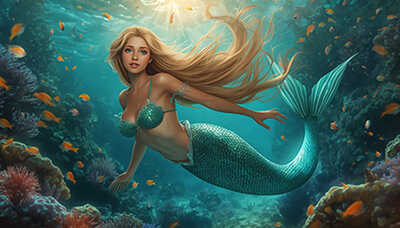
Undines are the spirits of water, sometimes referred to as nymphs. Undines can live in both fresh and salt water. They love to play in the spray of waterfalls and in mountain streams. They closely resemble humans in size but may also be smaller depending on the body of water that they inhabit. The name “undine” comes from the Latin word “unda” meaning wave or water. Some view mermaids as a kind of undine of the ocean.
Undines and the Emotions
Water represents the emotions. In the case of undines, they are believed to possess a refined nature that exemplifies love, beauty and grace. Undines are usually depicted as female, just as gnomes (see below) are usually shown as male, even though both of these types of nature spirits exist in male and female form.
Relationships Between Humans and Undines
Relationships between nature spirits and humans are also legendary. These are usually between a female undine and a male human. For example, a romance book written by Friedrich de la Motte in 1811 was the inspiration for the modern tale of The Little Mermaid.
Mermaids in Myths and Legends
Mermaids have figured in myths and legends for just about forever! They have been associated with sea goddesses including Calypso, Amphritrites, Thethys and Ran (Norse). They are also associated with love goddesses like Aphrodite and Venus. According to Beatrice Phillpotts in her book Mermaids, these mythical creatures beckon to the adventurous and promise both risk and forbidden desires.
Mermaid Symbolism
Mermaids symbolize love, beauty, mystery, allure, sensuality, untamed femininity, persuasion and perception. Mermaids are often shown holding a comb made of fish bone. The fish bone is an ancient nautical symbol of control over the sea and nature. Other mermaids are shown holding a mirror, a symbol of their somewhat narcissistic personalities.
Mermaids in Ancient Cultures
Mermaids appear in every culture on earth. The first recorded half-fish, half-human creature is Oannes, a Babylonian God from the 4th century BC. In Germany mermaids are called Meriminni, in Iceland they are Marmenill, in Holland they are Maremind, in Ireland they are Merow and so forth. Mermaids also figure in eastern lore in both India and China. Mermaids are elusive, only appearing in the light of moon between dawn and dusk and only to the true of heart. These are magical times when sight and perception are malleable.
The Danger of Sirens
Sirens are powerful sea-dwelling mermaids that are both fascinating and dangerous. Sirens figure in Greek mythology as beguiling creatures with voices so sweet that they lure sailors into destroying their ships upon the shore or rocks. They are said to entice mortal lovers to follow them beneath the sea.
Mermaids in the 4 Elements of Nature
Mermaids can also be likened to the undines, an elemental spirit said to inhabit all types of water and to ensoul this aspect of nature. Undines are one of four types of elementals. The others are the fiery salamanders (fire elementals), sylphs (wind elementals), and gnomes (earth elementals).
Mermaids and Manatees
Some historians believe that mermaids are the fictionalized versions of manatees. In fact, the scientific name for manatees is Sirenia. Manatees are large, slow-moving sea cows with little real resemblance to the fabled mermaids. Christopher Columbus is credited with the first modern sighting of a manatee during his 1492 voyage across the Atlantic Ocean.
Mermaids in Modern Culture
Mermaids and mermen continue to figure in modern literature and movies, including the lake-dwelling merpeople in the Harry Potter series and Disney’s Little Mermaid. In addition, mermaids call to us from almost every corner in urban America as the emblem of Starbucks.
See art, prints & posters at Kathleen Karlsen Gifts.
4 Elements of Nature in Artwork
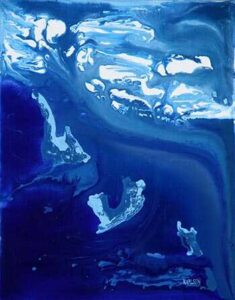
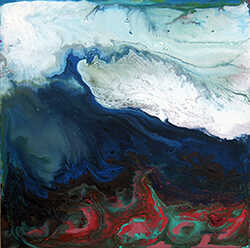
Water paintings alternately soothe and calm us or excite us with the reminder of fun, holidays and leisure time. Water paintings help to balance environments with lots of fire elements such as red, yellow and orange colors. Water paintings can serve a similar purpose to other water features in interior design: fountains, fish tanks, indoor ponds and waterfalls. Water paintings are perfect for bedrooms, dining rooms and places where you want to relax and recuperate.
The Fire Element and Water Symbolism
Another aspect of ocean paintings is in the non-physical realm. Sunshine on water brings in the secondary element of fire. Sunshine on water is one of the greatest visual thrills available in nature. Sunshine on water has been the subject of poems, songs, photography and artwork as far back as recorded history.
Symbolic Meaning of Sunshine on Water
References to sunshine on water in literature are also quite powerful and have been including in the literature of many cultures. References to sunshine on water can also be included in more generic inspirational quotes: Laughter is like the sunshine that sparkles upon water. Sunshine on water is endlessly entrancing.
See art, prints & posters at Kathleen Karlsen Gifts.
4 Elements of Nature: Gnomes of the Earth
Gnomes are earth dwellers who often work with minerals, stones, flowers, greenery, gems, and metals. They are said to be the guardians of hidden treasures. Gnomes are also said to be caretakers of shrubs, trees, gardens, and fields. Gnomes are healers of the earth and of humans. For example, gnomes are thought to help help mend broken bones.
The Origin of Gnomes
The name “gnome” is possibly derived from the Greek word “genomus” meaning an “earth dweller.” Some gnomes are believed to live in caves beneath the surface of the earth. The appearance of gnomes may change based on the part of the earth that they tend. Gnomes caring for poisonous shrubs, for example, may be small and ugly. Those caring for large, beautiful trees may be much larger and more attractive. Typically, gnomes are smaller than humans.
The Personality of Gnomes
The personality of gnomes also varies widely. They may be friendly or malicious. However, even the treacherous ones will be helpful once they have been befriended. Female gnomes are called gnomides. Elves are a common alternate form of gnomes. Elves may live in houses or barns rather than in direct contact with the earth. All forms of gnomes are purported to be both stubborn and brave. In their best forms, their deepest desire is to transform the physical world and nature into something of great value and beauty.
Working with the 4 Elements of Nature
Some believe that miracles can be worked through communion with nature spirits. The spirits can be wooed through song and chant, and can also be commanded by mankind since they are in a lower spiritual position on earth. Some adherents believe that even mountains can be ensouled by powerful nature spirits.
Communicating with Nature Spirits
Some individuals claim to possess special abilities to contact and interact with the beings of both the supernatural and the natural worlds. These individuals may have a role similar to traditional shamans. The messages which they receive and the interactions they have with other realms may become guides for others.
Author’s Story About Fairies
My mother is particularly devoted to visiting ancient sacred sites. One time they were far off the road in a farmer’s field at the location of a small dolmen. My grandparents (from the Irish side) were traveling with them, and they decided to have a picnic at the site.
My mother heard the fairies singing while they were there, but did not say anything to the others who were less inclined to such things. When they’d finished eating, they got back in the car.
Suddenly my grandmother turned to my mom and said, “Where were the school children that I heard singing?” My mother said, “Oh! You heard them, too!” As far as my mother was concerned, that confirmed the presence of the fairies!
Kathleen Karlsen is an author, musician, artist, and composer. She has written three books (The Color-Music Connection, Flower Symbols, and Vocal Medicine) and over 200 articles. Her YouTube channel features over 600 videos. Kathleen and her family live in Bozeman, Montana, USA.
Watch hundreds of videos on our YouTube channel!
![]()
Please Visit Our Store!


